
Anton Friisgaard: Systems for happy accidents
Inside the making of EMS Synthi 100 building blocks, a new sound pack recorded on Iannis Xenakis’ original instrument at the Athens Conservatoire.
Anton Friisgaard is drawn to ideas that are interesting to do.
That might mean performing live tape loops with the string trio Halvcirkel, spending six years developing Teratai Åkandewith Balinese gamelan musicians, or exploring an unfamiliar piece of equipment until it opens a new way of working. The results vary widely, but the impulse behind them is consistent: find a process with enough depth to get lost in, then follow it.
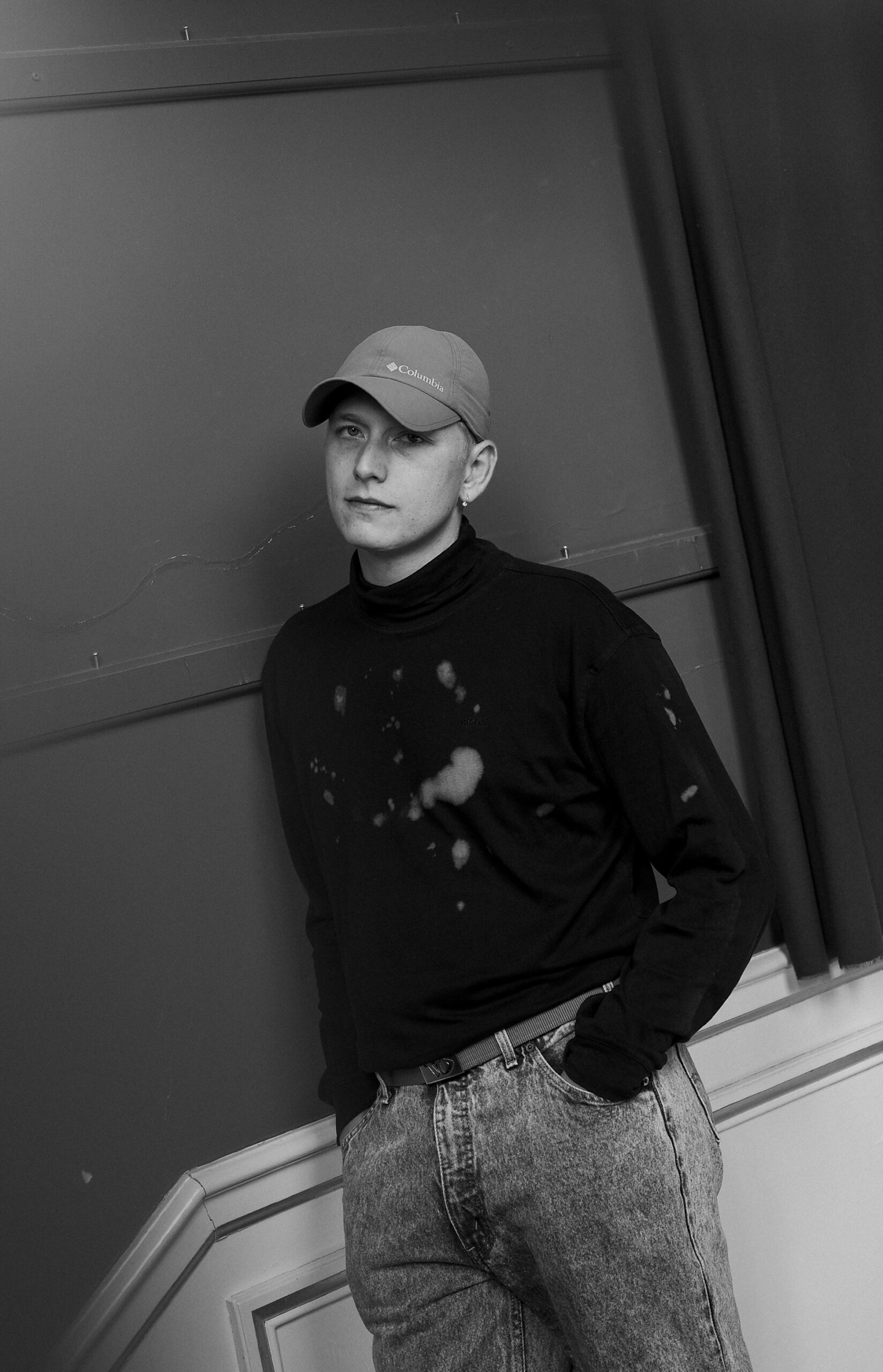
“I’m quite interested in the process, and I tend to gravitate towards projects that provide deep rabbit holes for me to discover.”
His new sound pack, EMS Synthi 100 building blocks, began with one such rabbit hole: a residency in Athens and the opportunity to work with one of the world’s rarest synthesizers.
An instrument with a history
Friisgaard travelled to Athens with Oscar Friisgaard for a residency at the Danish Institute at Athens and KSYME, the Contemporary Music Research Center at the Athens Conservatoire. In its basement sits a recently restored EMS Synthi 100, originally brought to Athens by composer Iannis Xenakis, who also founded KSYME.
Xenakis was a composer, engineer and architect who changed how music could be conceived. Drawing on probability, mathematics and physical models, he developed new ways of organising sound and was an early pioneer of computer-assisted composition, granular synthesis and immersive, spatial work. His connection to this particular Synthi 100 places the instrument within a longer history of treating technology not simply as a means of producing sound, but as a way to imagine new forms of music.
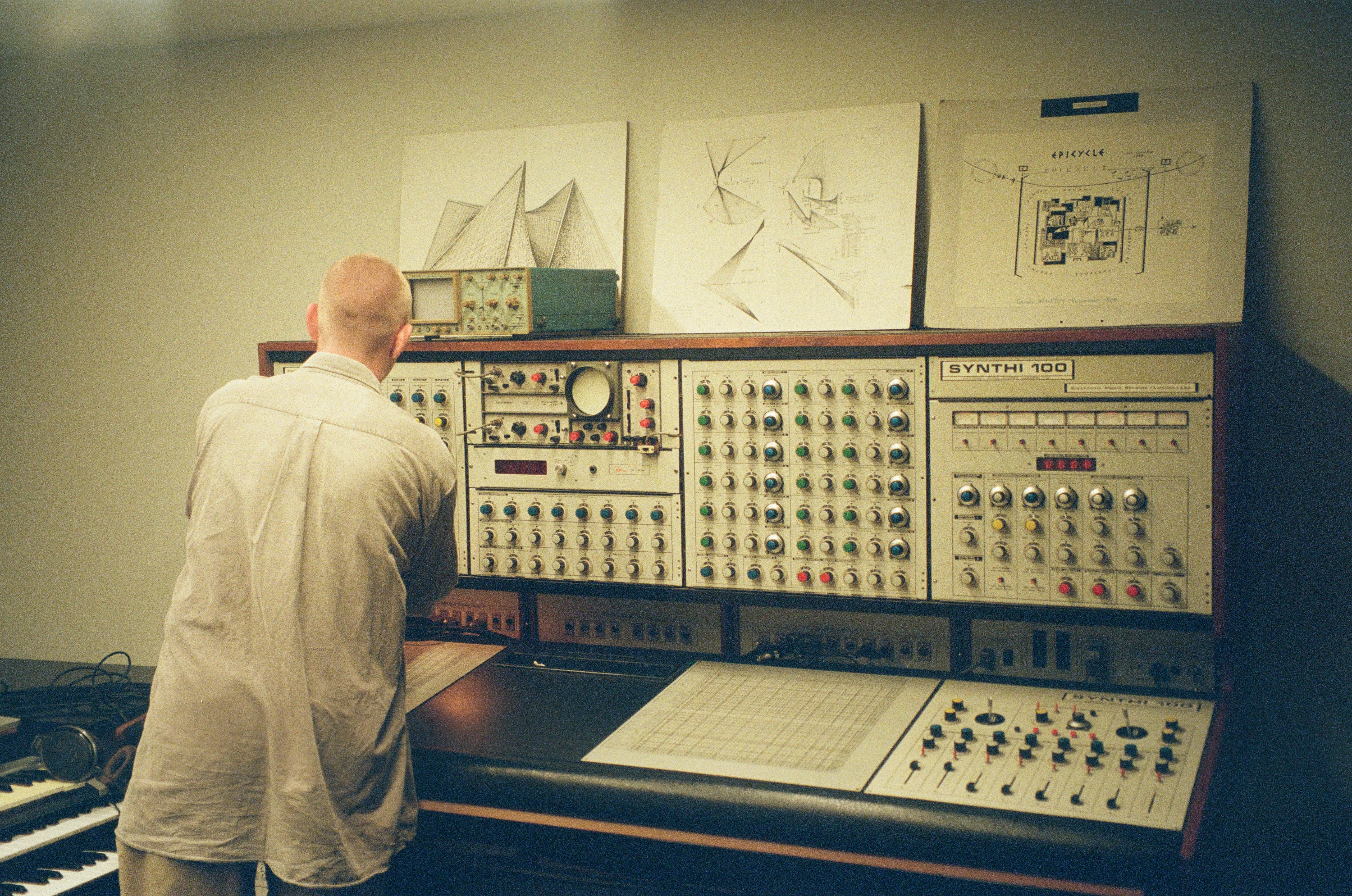
Photo by Pete Lamberto
The Synthi 100 is less a conventional synthesizer than a complete electronic music studio. Its sprawling interface brings oscillators, filters, envelope shapers, ring modulation, sequencing, routing and spring reverb together in one instrument. Working with it means entering a particular logic, one shaped as much by its scale and limitations as by its sound.
Those limitations suit Friisgaard. Across his practice, old synthesizers, reel-to-reel tape machines and even laboratory equipment become frameworks for discovery.
“Constraints in general make me more creative,” he says. “Archaic synths, lab equipment or reel-to-reel tapes provide quite clear boundaries for what’s possible and what isn’t.”
Building systems, capturing accidents
Friisgaard’s music often begins by constructing a system with room to move. The setup establishes a direction without deciding exactly what will happen within it.
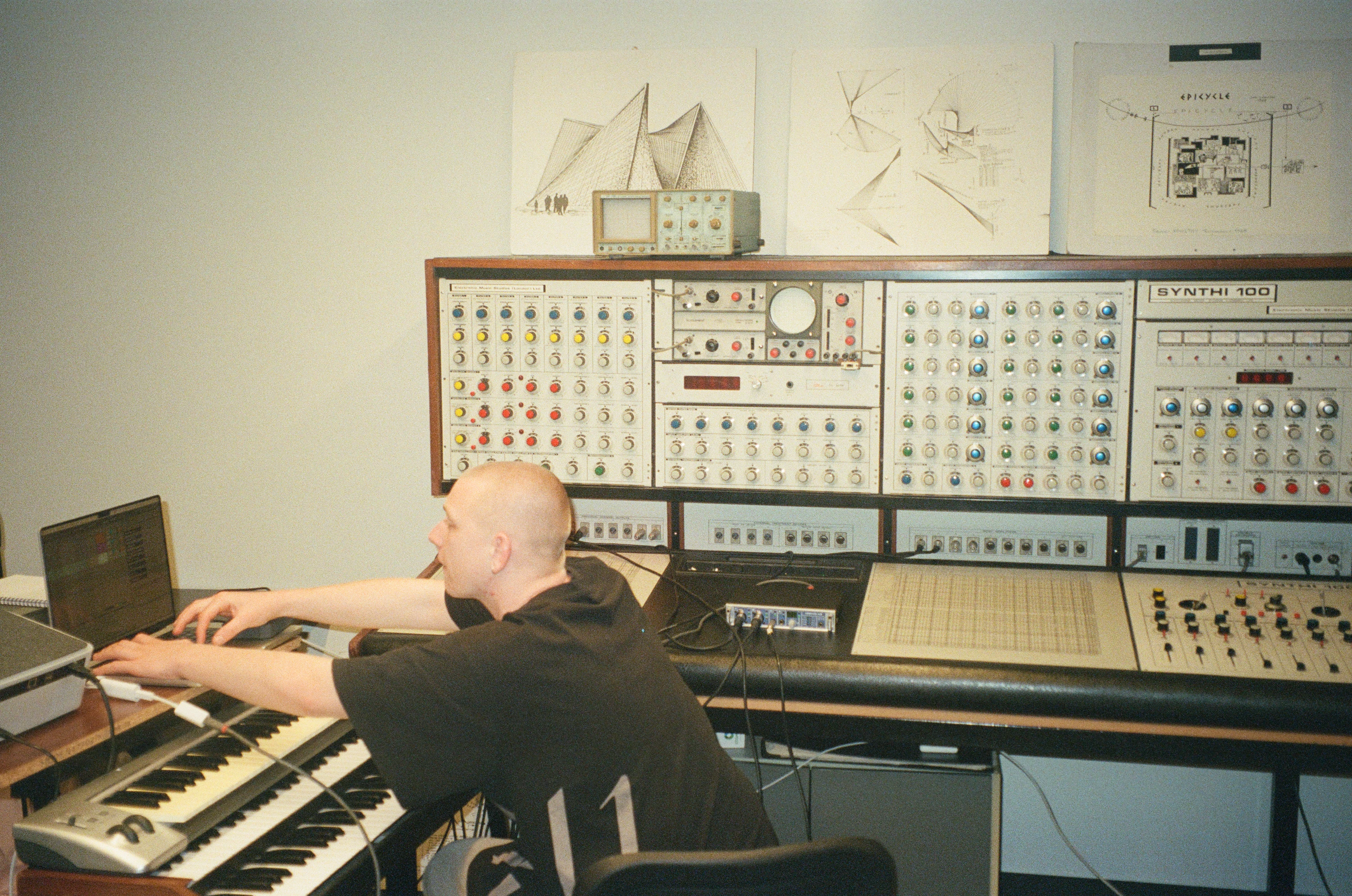
Photo by Pete Lamberto
“I like setting up systems that can produce happy accidents,” he says. “I always feel like having a sort of arm’s-length relationship to the sounds when I’m making music. I think that’s why I ended up in electronic music. It allows you to capture something amazing that happened once and was never intended.”
Intent enters later, through the choices that give those moments shape: processing, arranging and placing them in context. Friisgaard describes the balance as roughly equal parts intention and accident.
Time is another part of that process. Rather than deciding immediately whether an idea works, he prefers to step away and return with some distance.
“Sometimes you get married to an idea that needs to be killed instead,” he says. “Giving a project some time really exposes that.”
The same openness carries into his live practice. His performances are not built from a clean slate, nor are they fully predetermined. Instead, he prepares routings and functions that can be played in the moment, creating a framework with a clear direction and enough freedom to react.
With his evolving tape-loop performances, the studio and stage are particularly close. In both settings, he layers sound on sound until something clicks. The live set becomes a curated collection of those processes, still able to change each time it is performed.
Inside the Synthi 100
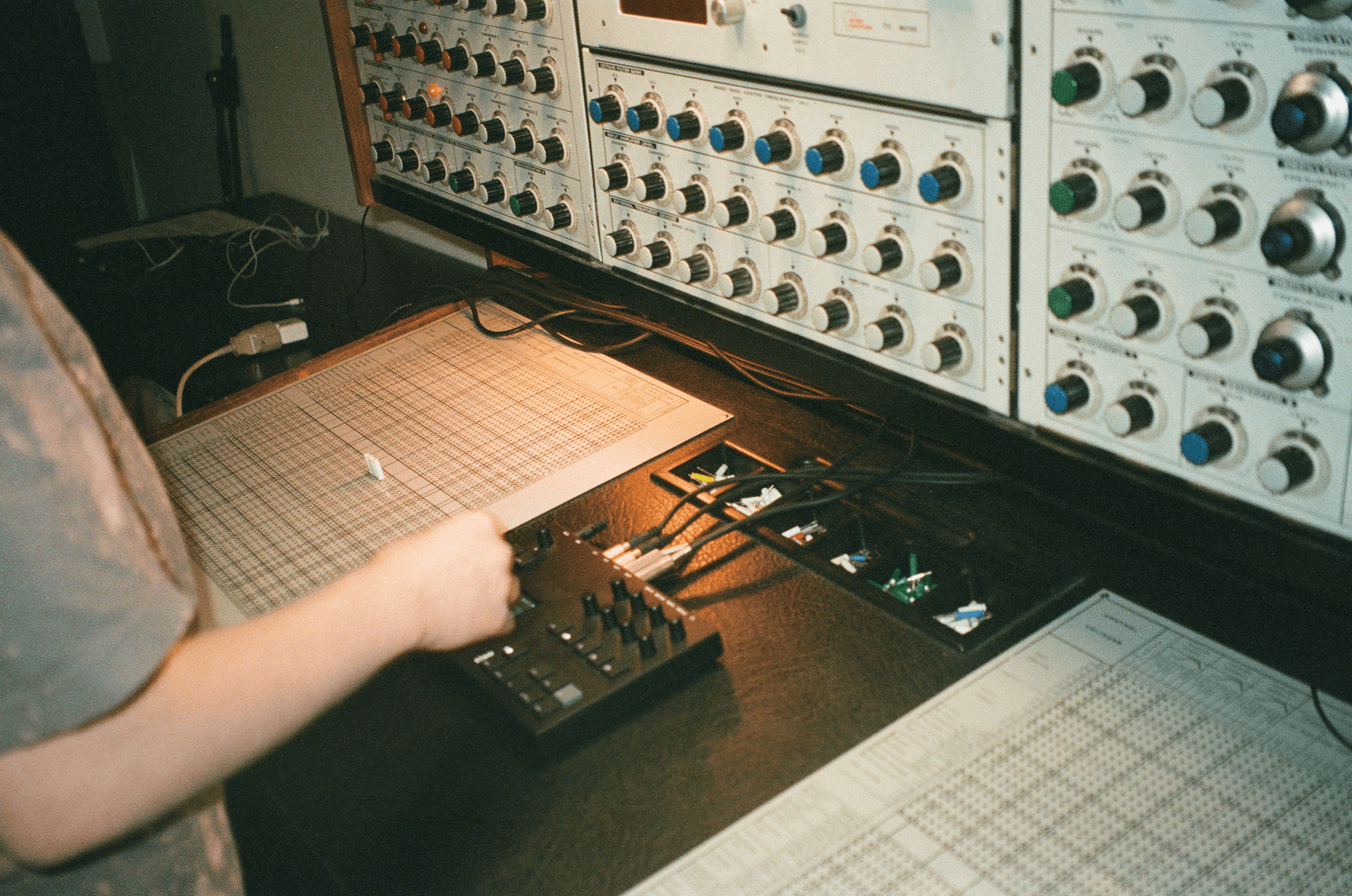
Photo by Pete Lamberto
Friisgaard, Oscar Friisgaard and artist Oliver Torr spent many hours recording the Synthi 100 during the residency. Some of the resulting material is intended for an upcoming spatial concert project. Another selection became EMS Synthi 100 Building Blocks.
For the pack, Friisgaard focused on sounds that could remain open in someone else’s hands: rhythm loops, drum one-shots, harmonies, effects and bass sounds ready to be pitched, layered and transformed. Alongside these adaptable sources, he kept a few sounds with a more distinct character.
“I couldn’t help myself entirely,” he says. “I also included a few sounds with a lot of character, to keep the pack inspiring.”
Among the instrument’s defining features is its ring modulator. Combined with oscillators that drift slightly out of place, it produces tones that feel full, unstable and organic. Many of the sounds in the pack are made from two or more ring-modulated oscillators and can be found under the RINGMOD label.
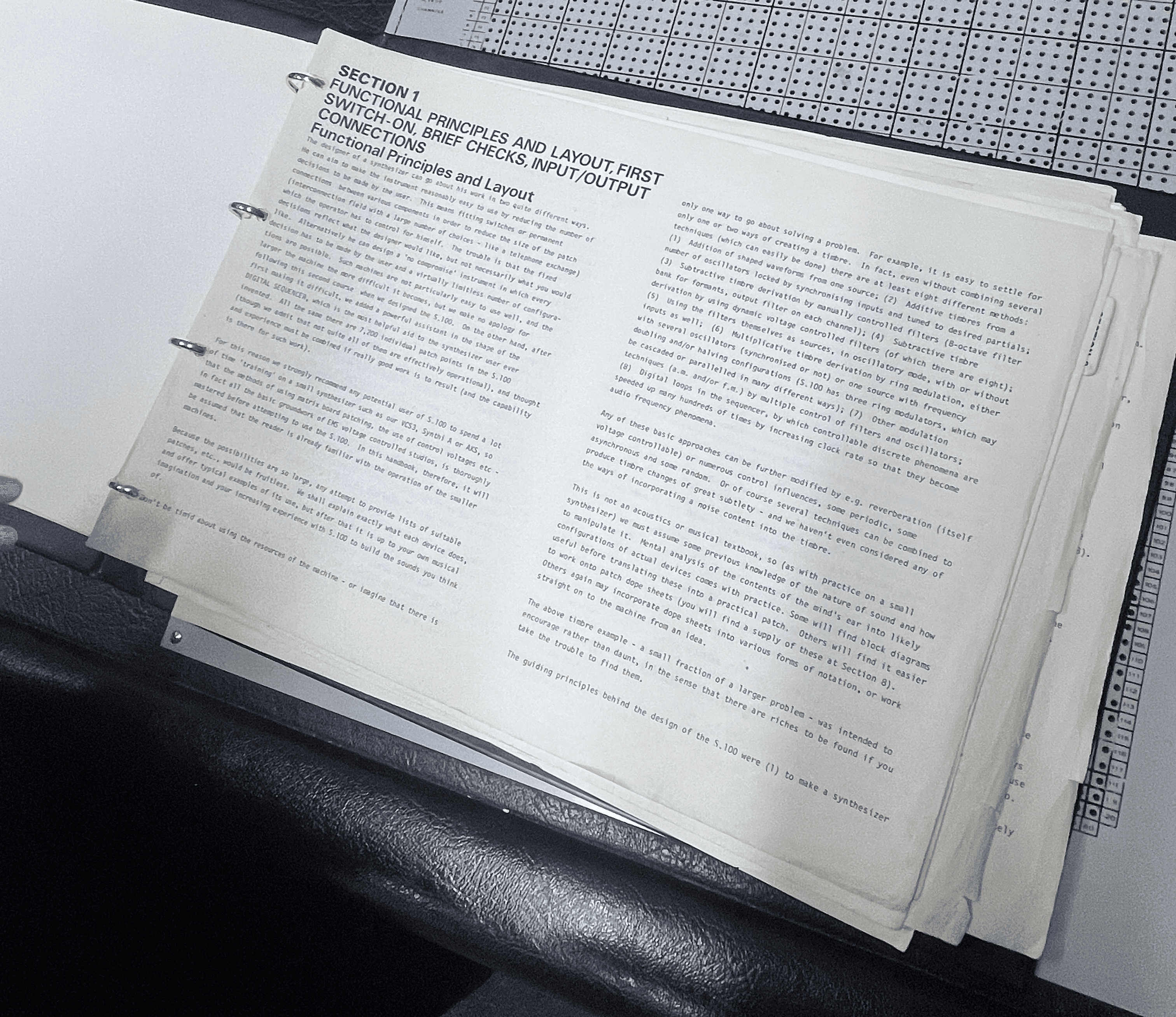
Photo by Pete Lamberto
The pack also led Friisgaard into less familiar territory. KICK LAZER GROOVE I & II are direct, techno-leaning drum loops, created while looking for a way around the Synthi 100’s elaborate internal sequencer. The solution was simple: a very slow square-wave pulse triggering pitch and volume envelopes.
“The oldest trick in the book,” he says.
Rather than treating the Synthi 100 as something to document from a distance, Friisgaard also brought an S4 into the KSYME basement. Running the two instruments together allowed him to record, process and reshape the Synthi as part of a more immediate setup.
“I used the combination as a kind of proof of concept for myself, to hear if it had the magic I was hoping for,” he says. “I’m very happy that it did.”
A starting point, not a finished statement

The title building blocks describes both the material and the invitation behind it. These are not finished compositions or fixed gestures, but sources designed to take on new forms. The pack carries the drift, saturation and physical character of the Synthi 100 without prescribing what should be made from it.
That openness connects the pack to Friisgaard’s broader practice. A useful sound is not necessarily one that arrives complete. It is one that suggests a process, establishes a set of possibilities and leaves enough space for an unexpected result.
“I’ve designed the pack so that it can go a million ways,” he says. “I just hope that other musicians and sound designers feel free to go down their own rabbit holes.”
