
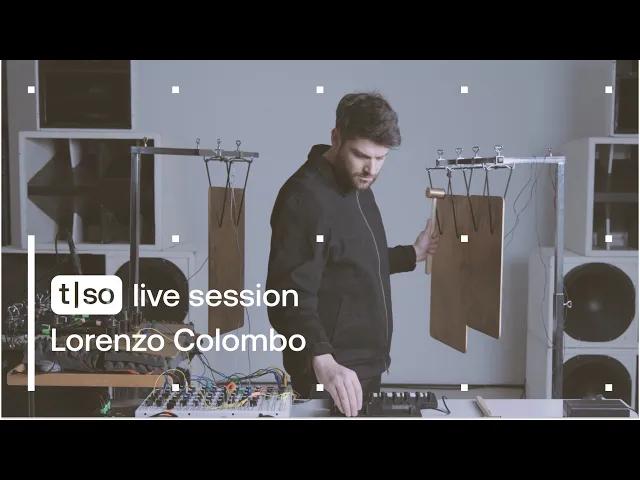
Lorenzo Colombo on metal, resonance, and rhythm
Sounds is our growing series of releases made with artists whose approaches to sound we find interesting, created as material to explore with the S4.
For this edition, we invited Copenhagen-based percussionist and sound artist Lorenzo Colombo to explore the electronic possibilities of metal instruments, drawing on his background in contemporary classical music and experimental performance. You can find his pack, metal instruments, here.

His work moves between percussion, electronics, and multimedia performance, with a particular interest in the possibilities that emerge when conventional approaches to instruments are reconsidered.
For Lorenzo, metal has long been more than a source of percussion. Its resonance, instability, and complex frequency content offer a way into sounds that can feel almost electronic before any processing begins.
From percussion to electronic music
Beginning his musical journey as a classical percussionist meant spending time around instruments with very different physical behaviours: drums, gongs, tuned percussion, and objects whose musical potential could be explored and transformed.
Metallic instruments became particularly important.
Bell plates, tam-tams, and tuned gongs produce sounds that are difficult to reduce to a simple pitch or transient. Their overtones interact, frequencies drift against one another, and sustained resonances create internal movement of their own.
That complexity gradually became a bridge towards electronic music.
Rather than treating an acoustic instrument as a fixed voice, Lorenzo became interested in what could be extracted from it. A resonance could become a drone. Interacting frequencies could produce rhythm. A small physical gesture could generate something closer to granular synthesis than conventional percussion.
An important reference throughout this exploration has been Karlheinz Stockhausen's Kontakte, composed between 1958 and 1960. In the work, electronic and percussion sounds continually move towards one another, sometimes becoming difficult to distinguish.
That relationship remains central to Lorenzo's approach: not using electronics to replace acoustic instruments, but listening for electronic qualities already present inside physical objects.
Rhythm inside resonance
The recordings were made at the Royal Danish Academy of Music together with sound engineer John Cleworth, concentrating on instruments whose acoustic behaviour could generate unexpected material.

Bell plates form one of the main starting points.
Struck with different beaters and combined with resonators, their long decays begin to interact. Closely spaced frequencies create beating patterns, turning what first appears to be a sustained tone into something rhythmic and constantly shifting.
Rather than removing those irregularities, the recordings follow them.
In another set of experiments, the bell plates are repeatedly excited to create what Lorenzo describes as "micro-beats": dense granular patterns whose timing emerges from the physical interaction between performer and instrument.
They resist conventional quantisation. Small differences in timing accumulate, producing rhythmic structures that feel organised without settling into a rigid grid.
A similar process is applied to tuned gongs. Here, the resulting material becomes a series of waves, with different densities, speeds, and forms of movement emerging through repeated gestures and sustained resonance.
Rhythm, in this context, is not something imposed on the instrument afterwards. It already exists inside the material: in beating frequencies, decay times, repeated movements, and the slight inconsistencies of performance.
Instruments that refuse simple tuning
The Sixxen introduce another kind of instability.
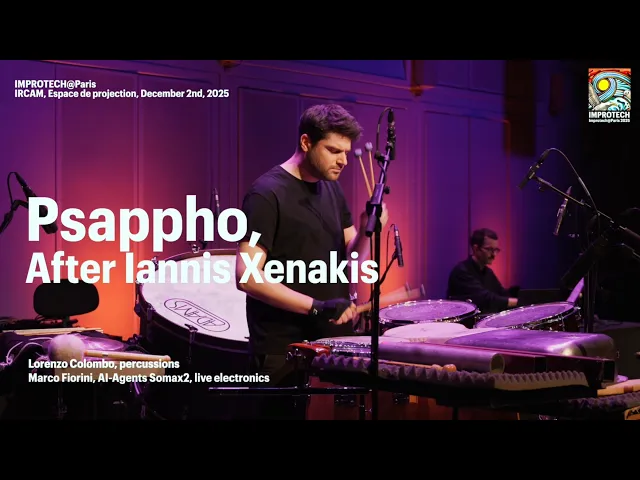
Designed by Iannis Xenakis for Pléïades in 1979, the instruments consist of metallic bars tuned according to a deliberately unconventional system. Lorenzo personally tuned the Sixxen at the Royal Danish Academy of Music together with colleagues in 2018, while preparing a performance of the work.
Their tuning produces dense combinations of frequencies that sit outside familiar harmonic relationships.
For this reason, they occupy an interesting space between percussion and pitch. Individual notes can be heard clearly, but combinations quickly form more ambiguous harmonic fields.
That ambiguity is precisely what makes them interesting as source material.
Across these recordings, the instruments are approached less as finished sounds than as physical systems. Their construction, tuning, resonance, and response to touch determine what happens next.
The final recordings extend the same thinking into rhythmic cells and performed patterns. Again, precision is not the main concern. The focus is gesture: the acceleration and slowing of repeated movements, inconsistencies between attacks, and the way rhythm changes when it is performed rather than programmed.
Taken together, the material points towards a simple idea.
Electronic sound does not necessarily begin with electronics. It can begin with a sheet of metal vibrating in a room, two frequencies interfering with one another, or a repeated gesture gradually falling out of alignment.
The transformation starts by listening closely enough to notice what the instrument is already doing.
About Lorenzo Colombo
Lorenzo Colombo is a Copenhagen-based percussionist, performer, and sound artist working across contemporary music, experimental performance, and electronics. He is a founding member of NEKO3 and several other ensembles, and teaches percussion and post-instrumental and multimedia performance at the Royal Danish Academy of Music, where he received his Soloist Diploma in 2023.
His work includes collaborations with composers such as Simon Steen-Andersen, Simon Løffler, and Alexander Schubert. He received the Léonie Sonning Talent Prize in 2022 and is the founder of the independent record label Don't Look Back.
Find out more about Lorenzo here.
