
Frank Bretschneider on patterns, systems, and repetition
Sounds is a growing collection of material made by artists we look up to and designed to be explored with the S4. For this next deep dive, we turn to Frank Bretschneider, a German electronic musician whose work has long moved through rhythm, reduction, abstraction, and the transformation of simple material.
Bretschneider has been active since the 1980s, first experimenting with tape machines, synthesizers, and modified guitars before forming AG Geige in 1986. He later co-founded Rastermusic with Olaf Bender, which became part of Raster-Noton in 1999, and has also released music under the name Komet.
Across these different contexts, his work returns to patterns, grids, pulse, repetition, and small shifts in structure. It is often precise, but rarely static. A simple source is set in motion, then allowed to change through routing, processing, and time.
Simple material, moving systems
For this release, Bretschneider began with a direct idea: to create simple, minimal drum loops that still carry a certain complexity. That aim sits close to his broader practice.
“I've always loved playing around with patterns and grids, repetitions, and loops,” he says. “In that sense, working on drum loops was right up my alley.”
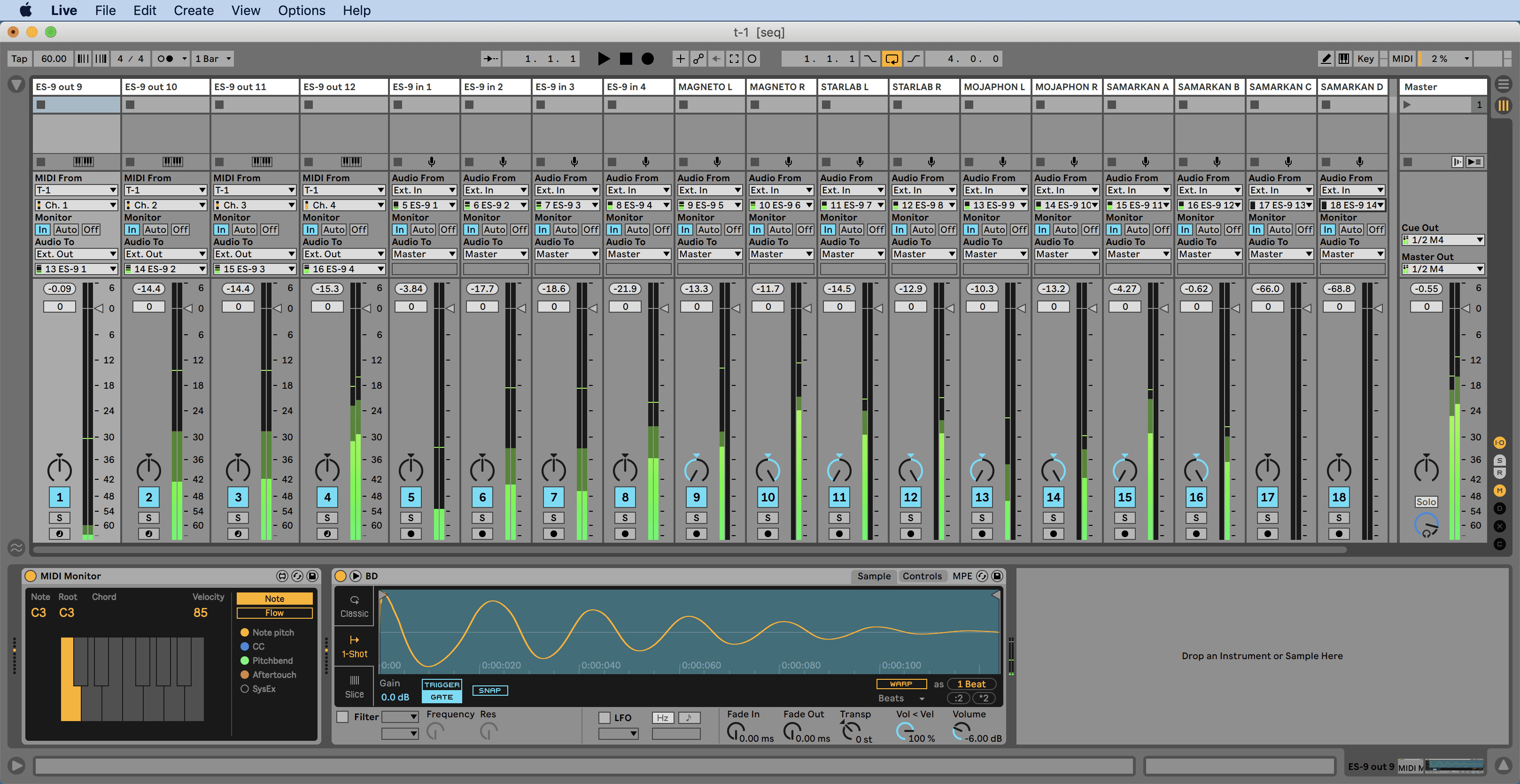
The process began in Ableton Live, used mainly as a sound generator. Bretschneider loaded kick, snare, hi-hat, bass, and other samples into four MIDI instruments, mostly using Simpler in one-shot mode. Sequencing came from the Torso T-1, which controlled pitch, duration, and volume while also sending clock to the modular system.
From there, the material left the computer and entered an external effects setup, where the main transformations took place. For Bretschneider, this is where simple sounds begin to open up.
“Since I’ve been preferring hardware over software for a few years now, I’ve put together an external modular effects array that allows me to process the sounds from soft/hardware sound generators externally,” he explains. “This includes various combinations of delay and reverb units, granular effects, filters, distortion, and resonators, which allow me not only to modify the sound in terms of frequency and spectrum, but also to create entirely new patterns and textures through looping, layering, granular processing, and freezing.”
Delay, routing, and chance
Delays are central to Bretschneider’s setup. He describes them as his favorite effects because they can move between many roles: feedback, chorus, flanging, reverb-like space, echoes, and repeating musical phrases.
In his modular system, six delay processors can each have tempo, time, and feedback controlled by CV. Alongside granular processors, filters, equalizers, distortion, reverb, and matrix routing, they form a system that can be adjusted, played, and left to generate new movement.
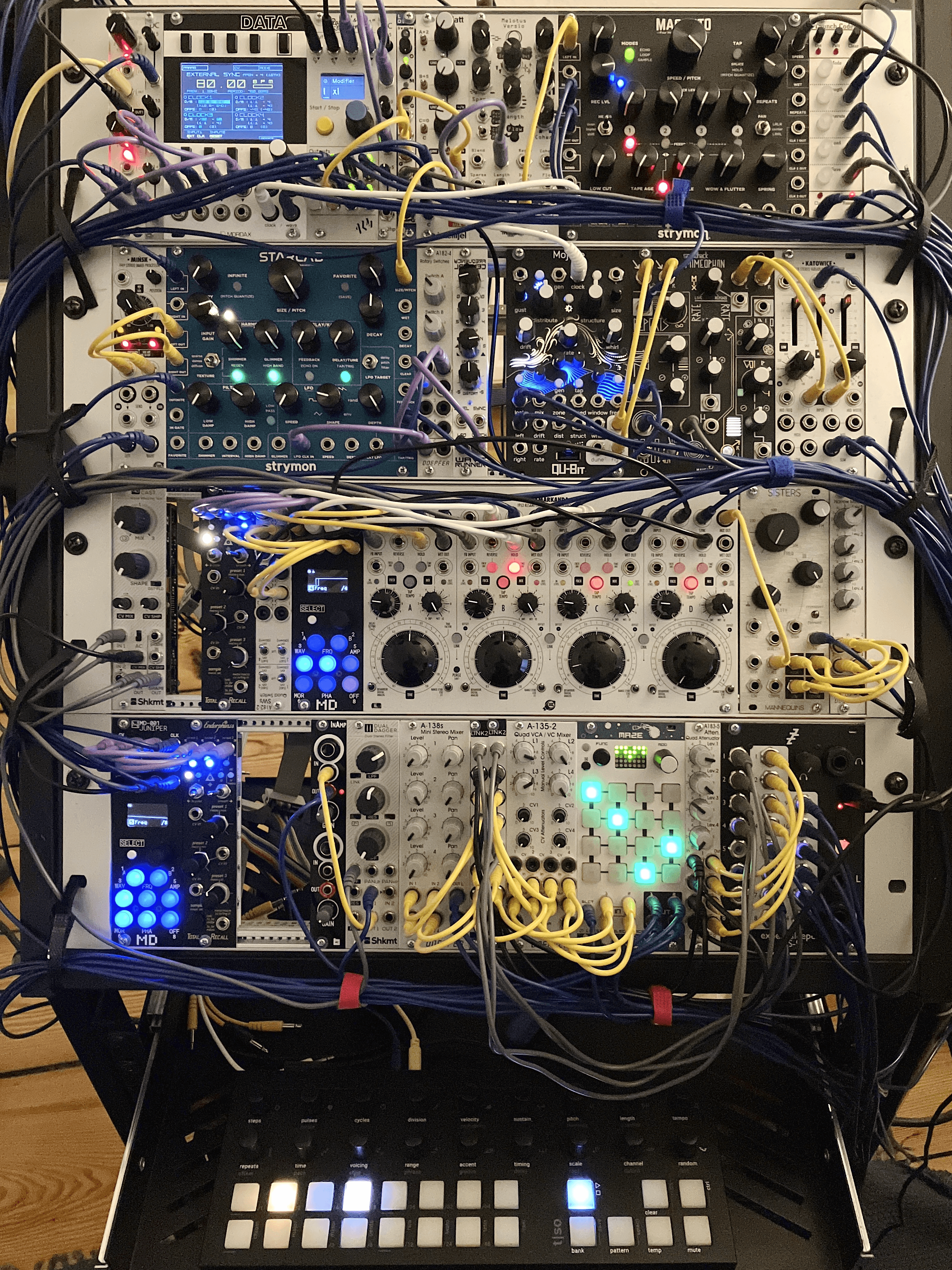
“The key parameters of all modules can be controlled via a total of 38 modulators,” he says. “This turns the system into a playground where I can quickly and intuitively manipulate and modify incoming signals across a wide range—whether tonally or rhythmically—and, if needed, have it operate in a self-generating manner.”
Although Bretschneider’s music is often associated with precision, the process leaves room for uncertainty. He does not begin with a fixed image of the final result. A piece becomes clear through working with the sequencer, adjusting the effects, and listening to where the system begins to move.
“I never know at the start how a track will turn out. It always becomes clear as I work with the sequencer and adjust the effects. I also like to work with random parameters, whether calculated or not. That means unexpected directions and twists are bound to happen, but I always try to keep the music lively and fluid.”
Patterns as starting points
The loops are offered in Dry, Wet, and Mix versions, giving access to the original rhythmic material, the processed signal, or a combination of both. Some Wet versions use mid/side processing to create a very wide stereo image, which requires care in mono or vinyl contexts.
That detail points back to Bretschneider’s broader way of thinking. A sound is not fixed once it leaves the studio. It changes through playback, mixing, routing, and use. It can become part of another structure.
“Maybe one or another of these loops will inspire someone to create a new piece of music, or help to enhance an existing one...”
For Bretschneider, repetition is not a closed form. It is a starting condition. A pattern can hold steady, shift, fracture, or generate something else. What matters is the movement inside it.
About Frank Bretschneider
Frank Bretschneider is a German electronic musician, composer, and visual artist. He began experimenting with tape machines, synthesizers, and modified guitars in the 1980s, formed AG Geige in 1986, later co-founded Rastermusic, and has released music under labels including Raster-Noton, 12k, Mille Plateaux, Fällt, and Bip Hop. He also records under the name Komet.

